
Book Review: Rescuing Reason: How History Education Can Help Save Democracy, Alan Sears and Carla L. Peck
Craig Findlay
As a Social Studies teacher in Alberta for the past 33 years, I have never felt the weight of our profession quite as acutely as I do today. Political polarization is reshaping our communities, an “age of distraction” fights for our students’ attention, and the coming wave of artificial intelligence promises to fundamentally challenge our perceptions and understandings of teaching and learning. In these challenging times, where many of us are experiencing a sense of moral distress as we struggle to preserve and sustain the foundational project of our liberal democracy, Dr. Carla L. Peck and Dr. Alan Sears have delivered a timely call to action with Rescuing Reason: How History Education Can Help Save Democracy.
The book offers far more than theoretical discourse; it provides a well-researched framework to navigate the important intersections of history education, civic reasoning, and critical thinking. Rescuing Reason reminds us of our duty as educators not to give students easy answers, but to equip them with the intellectual stamina to navigate difficult questions in a rapidly changing world. The book can help us empower young people to both see themselves in history and build a sense of agency and efficacy towards their future.
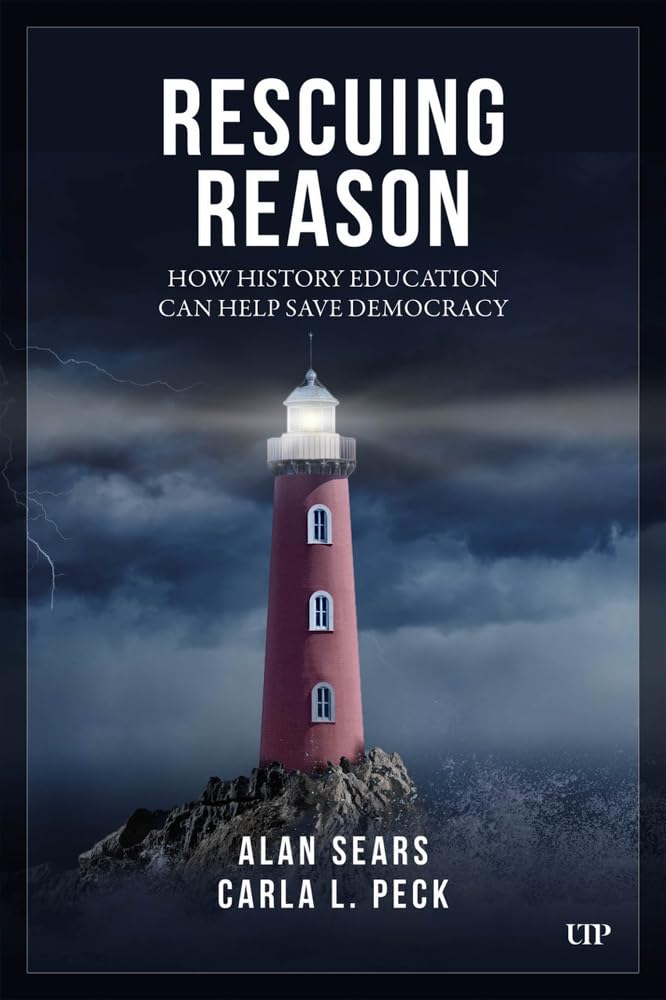
What makes Rescuing Reason so profoundly impactful for the classroom practitioner is how it maps out the synergy between historical thinking and active democratic citizenship. Dr. Peck and Dr. Sears expertly demonstrate how history education—when framed by the “Big Six” historical thinking concepts (historical significance, evidence, continuity and change, cause and consequence, historical perspectives, and the ethical dimension)—is not an exercise in memorizing static facts, but the very crucible in which civic reasoning is formed.
The book elegantly frames civic reasoning as a series of intellectual dispositions, including tolerance for ambiguity, cognitive flexibility to embrace complexity over certainty, and the humility to acknowledge the limits of our perspectives and understanding. The authors make a compelling case that to be an active and engaged citizen in a liberal democracy, a young person must be able to grapple with the inherent complexities, contradictions, and ambiguities of the past, the present, and the future.
For veteran teachers seeking to ground their practice in these volatile times, and for newer educators trying to find their footing, Rescuing Reason is an urgent and necessary guide. It reminds us why we stepped into the classroom in the first place, and powerfully reclaims the noble, democratic purpose of history and social studies education.
Sears, A., & Peck, C. L. (2026). Rescuing reason: How history education can help save democracy.
University of Toronto Press.

